2025-08-01
Short example LEDs
Human beings have influenced the climate with their behaviour quite dramatic.
Actual climate change is undisputed.
But still individuals do say:
„Me as a single person, I cannot change anything. Changing my behaviour is not saving the world.“
Well.
I would like to explain with a simple, even though technical, example why this is not acceptable.
Thanks to technology improvements many light sources are nowadays using LEDs instead of glowing wire bulbs.
The obvious advantage of LEDs is their higher performance converting electrical current into light.
The old bulbs converted the majority of electrical energy into heat.
Practical experience: touch an old 40 Watt bulb and a LED replacement. You will burn your finger touching the bulb. Don’t do it.
Which led to the solution in the industry to use LEDs.
This is all we have to do.
Wrong!
Don’t stop thinking here.
There is more we can do.
When I am studying modern implementations by looking at the schematics I do get the impression the developers have read the data sheet and are following the application notes without asking if the proposed solution is really the best solution.
When I refer to „best“ solution I also have the situation in mind under which it maybe the „best“ solution.
A traffic light in bright sun light must be visible, but during the night it is not necessary to have the same brightness.
But how can this knowledge lead to saving energy?
Let’s start by observing a single LED connected to an electrical source.

This is a typical implementation to connect a LED to an electrical source.
Usually the value for the resistor will be assigned as suggested in the datas heet.
I believe many developers read the typical values and that’s it.
What do we find in a data sheet?
Electrical values

What does this say?
When letting a current of 20mA flow through the LED the voltage drop is typical 2,2V and 2,5V maximal.
The value for the resistor can be calculated as (thank’s to Georg Ohm):
$$R ~=~ {U \over I} $$
With values:
$${(~3,3V~-~2,2V~) \over 0,020 A}~= ~55 Ω$$
These values will let the LED shine with a certain brightness usually named luminous intensity.
I can assure you looking direct to this LED will let you be blinded.
But this is not what I want to look at.
Question how much energy is this circuit consuming?
Now James Watt will be honoured.
The electrical power is calculated with:
$$P~=~U~\times~I$$
Modifying this by combining it with Ohm’s law:
$$P~=~I ^ 2~\times~R$$
and
$$P = {U^2 ~\over~ R} $$
The whole circuit above, resistor plus LED, is consuming
$$0,066W~=~3,3V~\times~0,020A$$
The total consumption equals to 66mW.
This doesn’t sound much.
Let’s look at it from a broader perspective.
Since a couple of months the world population has exceeded the 8.000.000.000 barrier and it will continue towards 10.000.000.000.
Let’s assume, and yes it is completely wrong but sufficient for illustration, each human being is using a device with one combination of resistor and LED as above.
This totals to:
$$8000000000~\times~0,066W~=~528000000W~=~528MW$$
One of the largest nuclear power plants generates ca. 1660MW.
To supply energy to feed that LED circuit one third of this power plant energy production is needed!
Résumé:
Development engineers do have the responsibility to avoid unnecessary energy consumption!
What might help:
Do not use only the numbers from the data sheet.
There is something else quite important:
the diagrams showing the relation between energy consumption and brightness.
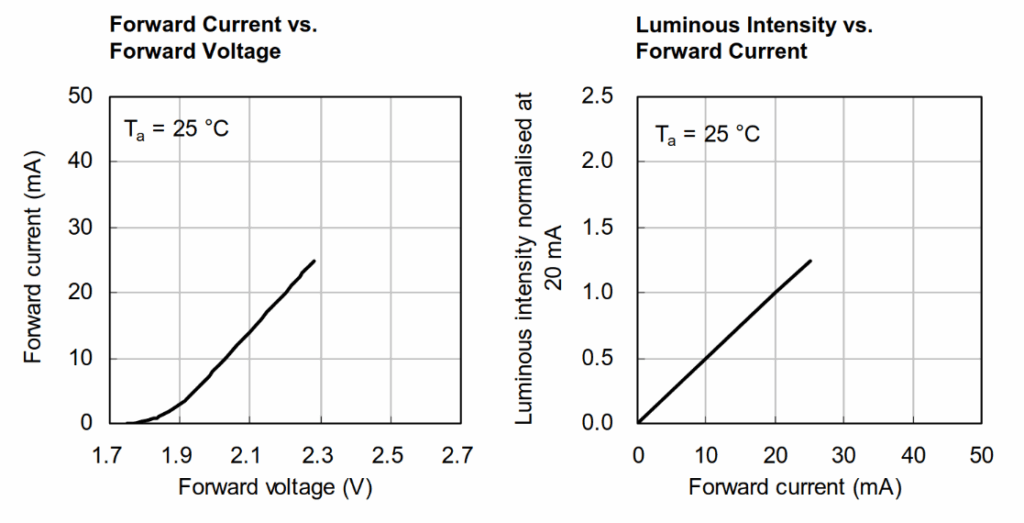
The interesting one is the right diagram, because it shows a normalised relation between current and brightness.
Let’s interpret it as :
Using a forward current of 20mA creates a brightness of 100%.
Usually all data sheet values, especially the life time, are based on the idea the device will always be used with 100%.
(By the way nobody can work with 150%.
Usually this indicates she/he was working with 66% only.)
A very old rule said:
You should not run anything at 100% continuously.
I reduce it to 80%.
This will increase the life time quite drastic (search for „bathtub curve“).
Following this let’s re-calculate our values.
$$3,3V~\times~(0,020~\times~0,80)A~=~0,0528W$$
For the world population:
$$8000000000~\times~0,0528W~=~422400000W~=~422MW$$
We only need a quarter of that power plant, because we are saving more then 100MW.
Consequences for our development engineers:
Re-calculate your circuit, but not without analysing what is happening to the brightness.
According to the diagram the brightness will be reduced to 80%.
Human sensibility to reduction of brightness from 100% to 80% is limited.
In a direct comparison it can be judged, but not stand-alone.
The first diagram shows that reducing the current leads to a lower voltage drop over the LED, let’s assume to 2V.
The resistor has now to compensate 1,3V at 0,016A.
$${1,3V \over 0,016A}~= ~81,25Ω$$
Choosing 82Ω from the E12 values should be OK.
This example is using standard LED technology.
Using modern LEDs is reducing the needed current down to 1mA, which means the energy consumption goes down to 3,3mW.
$$3,3V~\times~0,001A~=~0,0033W$$
Calculated for the the world population:
$$8000000000~\times~0,0033W~=~26400000W~=~26,4MW$$
I think this answers the question what can be done in an easy way to reduce energy consumption and with this reducing air polution and global warming.
An alternative solution is to use PWM (Pulse Width Modulation).

This method uses an ON/OFF approach, but not continuously.
The human eye cannot distinguish between optic events if they are faster following each other then ca. 16ms or 62.5Hz.
That’s the reason our alternate current nets use either 50Hz (20ms) Or 60Hz (16,66ms).
LEDs are usually fast enough to be turned ON for 16ms followed by a long OFF time.
The consumed power may now be calculated as the ratio between ON and OFF in %iges.
For example:
$${20ms \over 1000ms}~=~0,02 ~or~2\% ~duty~cycle~$$
That’s the reason why your smoke detector blinks only every 30s or even less often so the battery lasts longer.
Similar things should be calculated for media streaming vs. a CD/DVD, using internet searches vs. reading a book.
Buy once – use many times.
Yes, this is against the interest of some companies and they will do everything to avoid this.
But even these companies do realise earth resources are limited, or why do you think they want to go to the Moon, Mars or Asteroids?
Digging for resources and through them gaining profit!
I hope this short article triggers some kind of reflection.